Mattress Buying Guide
Choosing an Adjustable Bed for Natural-Fiber Sleep Systems
An adjustable base can lift the head, raise the legs, or bring both ends into a new position. Beneath it, a mattress must flex, remain supported, and return to shape night after night. When natural fibers and latex enter the picture, choosing a compatible sleep system means looking beyond labels and checking how every layer is built.
Published October 27, 2026
In a traditional bed, the mattress rests on a mostly level foundation. An adjustable bed changes that quiet arrangement into a moving one. Motors articulate the frame; hinges create bends; support points shift as the head or foot rises. The mattress travels with them, curving over the frame while carrying the sleeper’s weight. For a natural-fiber sleep system, compatibility depends not simply on whether the mattress feels flexible in a showroom, but on its core, upholstery, construction, dimensions, and the base’s movement.
Natural-fiber systems may combine latex, cotton, wool, silk, or other materials, sometimes alongside springs. These materials do not all respond alike. Latex is resilient and can flex with a changing surface. Wool and cotton add cushioning and absorb moisture, but thick or tightly secured upholstery may behave differently at a hinge than a thin knit cover. A pocket-spring unit has its own movement characteristics, and a highly structured foundation may be intended to remain flat. The task is to understand the whole assembly before placing it on a powered frame.
A measured approach can prevent avoidable problems: a mattress bowing where it should follow the base, a foundation that cannot articulate, a mattress shifting during adjustment, or a motorized frame being asked to carry more than its rated load. It also helps set realistic expectations. An adjustable base can change posture and convenience, but it does not automatically improve mattress support or resolve a health concern.
Start with the system, not the slogan
The phrase “natural-fiber mattress” describes materials, not a universal construction. One model may have a flexible latex core wrapped in cotton and wool. Another may use a dense spring unit beneath layers of wool, cotton, or silk. A third may include a separate box spring or foundation designed to work as part of the original set. Each construction will meet the repeated bends of an adjustable base differently.
Before comparing bases, identify what is actually in the bed. Look for the mattress’s core type, overall thickness, upholstery layers, border construction, and any instructions about bending or use with powered frames. Note whether the mattress is one piece or built from separable layers. Check whether a foundation is required, optional, or unsuitable for articulation. If information is unclear, ask the mattress maker for written compatibility guidance rather than relying on a general claim about latex, wool, or “flexible” materials.
That distinction matters because materials work together. A latex core may bend while an overly rigid border, thick quilted top, or integrated support structure limits the mattress’s movement. Conversely, a mattress designed for flex may still perform poorly on a base that concentrates pressure at sharp hinge points or leaves long sections unsupported. Compatibility is a relationship between mattress and base—not a property that can be inferred from one ingredient.
Check the base’s movement and range
Adjustable bases vary in how far they lift, which sections move, and how smoothly they travel between positions. Some raise the head only; others articulate both head and foot. Certain models provide preset positions, while others let users stop at intermediate angles. Before choosing, compare these functions with the way you expect to use the bed. A person seeking a modest upper-body incline may have different needs from someone who regularly raises both the head and legs.
Ask the manufacturer or retailer for the base’s range of movement and a diagram of its articulated sections. Find out where the hinges sit relative to the mattress and whether the platform remains supportive through the full range. A frame that bends dramatically may create different demands from one that makes gentler adjustments. The mattress manufacturer’s approved limits, if provided, should take precedence over assumptions based on a demonstration model.
Also consider the base’s controls. A wired remote, wireless handset, or app can make adjustments easier, but usability matters more than feature count. Check that buttons are easy to distinguish, that the handset can be reached from the intended sleeping position, and that the base can be returned to flat without navigating confusing menus. If the frame offers preset positions, learn what each one does rather than assuming a label describes a medically appropriate posture.
Some adjustable bases include massage functions, under-bed lighting, or programmable settings. Treat these as separate conveniences, not evidence of mattress compatibility. The essential questions remain whether the frame supports the mattress appropriately, fits the room and bed frame, accommodates the intended load, and can move the sleep system without undue strain.
Understand what “flexible” means in practice
A mattress that can bend by hand is not necessarily suitable for repeated articulation. A person testing a corner in a store applies a brief force in one place. An adjustable base changes the shape of the full sleeping surface and may repeat that movement every day. Over time, the construction must tolerate bending without the layers bunching, shifting, separating, or placing excessive stress on seams and quilting.
Latex is often used in adjustable-compatible mattresses because it can compress and recover. But latex products differ in thickness, firmness, layering, and surrounding materials. A latex core does not guarantee that every mattress containing latex can be placed on every adjustable base. Likewise, natural fibers in the comfort layers are not automatically a barrier: the relevant question is how those layers are assembled and whether the maker approves the combination.
Consider the shape the mattress must follow. When the head or foot rises, the surface bends at the base’s joints. A mattress that is too thick, too stiff, or too heavily structured may resist that curve. The frame may still move, but the mattress could lift away from the platform, form a pronounced gap, or experience strain. A mattress that is very pliable may follow the frame, yet still need adequate support across its length and width to avoid sagging.
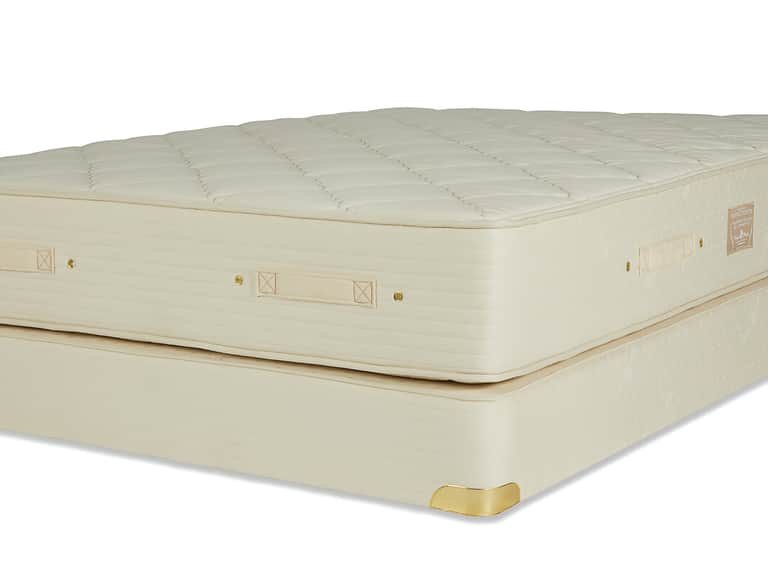
Construction details can be especially important around the perimeter. Reinforced edges, side-stitching, handles, and borders can help a mattress keep its shape in ordinary use, but their effect on articulation varies. Ask whether those features have been evaluated with the specific kind of adjustable base you are considering. Do not cut, remove, or alter structural components to make a mattress fit; doing so may damage it and could affect warranty coverage.
Natural fibers and a changing sleep climate
Natural materials are often chosen for their feel, breathability, and moisture-management characteristics. Wool can provide loft and help manage moisture; cotton is used in covers and padding; latex can contribute responsive support. Those properties may influence comfort, but they do not determine how a mattress behaves mechanically. A breathable cover cannot compensate for a base that bends at the wrong point, and an adjustable position does not change the material composition of the mattress.
Raised positions can alter how a person experiences pressure, warmth, or movement across the surface. Those sensations are individual and may depend on pillow placement, body shape, room temperature, and the angle of the base as well as the mattress. If a mattress feels unfamiliar when articulated, begin with a small adjustment and reassess the surface before using a more pronounced position. There is no single angle that is right for every sleeper.
For people choosing an organic mattress, certifications and material claims should be considered separately from bed compatibility. A certification may provide information about specified materials or manufacturing criteria, but it does not, by itself, confirm that the mattress is suitable for a powered frame. Look for two distinct answers: what the mattress is made of, and whether its maker supports its use on the particular adjustable base.
Read the compatibility guidance carefully
Compatibility language can be brief. “Adjustable-base compatible” is useful, but a buyer should still confirm which base type is meant, whether a separate foundation is required, and what restrictions apply. Ask whether compatibility covers the mattress alone or a complete set that includes a foundation. If a seller describes a mattress as suitable for a platform, that statement should not be taken as proof that it is suitable for an articulating platform.
Warranty terms deserve close reading. Some warranties specify the kind of support surface required, the spacing between slats, or the need for a rigid center support. Others may address damage caused by improper foundations or use. A mattress can appear to work on a base at first and still be installed contrary to the manufacturer’s requirements. Save the product documentation and any written answers about compatibility before purchase.
One example of a product description that explicitly identifies adjustable-base use is the Royal-Pedic Natural Latex Quilt-top Mattress with German Stretch Knit ticking. Its listed construction includes a natural latex core, cotton, and wool, and the description states that it may be used on an adjustable bed base. That statement is product-specific; it should not be generalized to all latex mattresses or treated as a substitute for checking the base’s own requirements.
The Naturally Organic Hudson Latex Mattress is also described as compatible with an adjustable base. Its listed construction includes layers of Dunlop latex wrapped to prevent shifting, with cotton and wool in the sleep surface. As with any mattress, confirm current instructions, model details, and warranty conditions directly before pairing it with a particular frame. Product specifications can change, and compatibility depends on the exact model and setup.
Measure the room and the whole bed
An adjustable bed occupies more practical space than its mattress dimensions alone suggest. The frame may need clearance to articulate, while its motor, power supply, cables, and moving sections require room beneath or beside the bed. Measure the room, doorway, stairwell, and route to the bedroom before delivery. Check the assembled base’s dimensions, not only the size printed on the mattress label.
Confirm that the base fits inside the existing bed frame, if you plan to use one. Some adjustable bases are freestanding; others are designed to sit within a compatible frame. Bed rails, footboards, headboards, and storage drawers can interfere with movement or access to the motor. Ask how the base attaches to a headboard and whether additional brackets are needed. Do not assume that a frame that accommodates a flat foundation will provide adequate clearance for an articulated platform.
Weight capacity is another practical consideration. Check the base’s stated limit and determine whether it includes the mattress, sleepers, bedding, and any accessories. For a split adjustable bed, ask whether each side has its own capacity and controls. A split setup can allow partners to adjust positions independently, but the central gap, mattress dimensions, and bedding arrangement should be understood before ordering.
Plan for setup, movement, and maintenance
Installation is part of compatibility. A base must be assembled on a suitable floor, connected to power as directed, and tested before the mattress is placed on it. Follow the manufacturer’s instructions for cable routing so wires cannot be pinched by moving components. Keep the area under the bed clear of objects that could obstruct the mechanism. If delivery or assembly is provided, clarify what the service includes and whether removal of an old foundation is covered.
Once assembled, test the base through its intended range without a person on it, if the instructions permit. Listen for unusual noises, watch for cables or bed-frame parts catching, and confirm that the platform returns to a flat position. Then place the mattress according to its orientation and allow the system to settle. Make adjustments gradually and check that the mattress remains centered, supported, and in contact with the base as it moves.
Follow care instructions for the mattress and its cover. Natural-fiber layers may have specific cleaning and ventilation requirements, while many covers are not designed to be removed or machine-washed. Avoid bending or folding a mattress beyond the manufacturer’s directions when moving it. Even a compatible mattress can be harmed by improper handling, and routine movement of the adjustable base is different from sharply folding the mattress for transport.
A practical pre-purchase checklist
Before making a decision, gather answers to a short set of questions. Clear responses from both manufacturers are more useful than a broad assurance that “most mattresses work.”
- Does the mattress maker explicitly approve the exact mattress model for use on an adjustable base?
- Does that approval cover the base’s movement range and the positions you plan to use?
- Is a separate foundation required, optional, or prohibited when the mattress is on an articulating frame?
- What mattress thickness, weight, and construction limits apply to the base?
- Will the mattress stay supported at the hinges and along the edges through the full range of motion?
- Do the mattress warranty and base warranty specify particular setup or support requirements?
- Can the base fit inside the existing bed frame without restricting movement or trapping cables?
- Are the remote, controls, and preset positions straightforward for everyone who will use the bed?
- Can you return or exchange the mattress or base if the pair does not work as expected?
Common assumptions to set aside
“All latex mattresses work on adjustable beds.” Latex may be flexible, but the complete mattress design matters. Quilting, borders, thickness, and manufacturer instructions can change the outcome.
“Natural materials make a mattress more compatible.” Material origin and mechanical performance are different questions. Cotton, wool, and latex can be valued for particular qualities, but none is a universal compatibility guarantee.
“If the base can lift, the mattress can follow.” The motor’s ability to move the platform does not prove that the mattress is suited to repeated bending. Approval should come from the mattress manufacturer and should match the base configuration.
“A compatible mattress will feel the same in every position.” Raising one end changes the sleeping surface’s angle and can change how pressure and body weight are perceived. Comfort should be assessed in the positions you actually intend to use.
“A more advanced base is automatically a better choice.” Extra features do not replace a careful fit check. A simpler frame with appropriate movement, support, controls, and dimensions may be a better match for a particular mattress and household.
Make the decision in three steps
A useful way to organize the process is to separate it into three checks: the mattress, the base, and the room. First, confirm the mattress construction and written compatibility guidance. Second, compare the base’s movement, support, capacity, and controls with the mattress instructions. Third, measure the room and existing frame, then plan delivery, installation, and cable clearance.
This sequence keeps an appealing feature list from overshadowing the basic fit. If the mattress maker cannot confirm compatibility, pause before purchasing the base. If the base’s movement or load limits are unclear, request its manual or technical specifications. If either manufacturer gives instructions that conflict, ask for clarification in writing rather than trying to resolve the difference by guesswork.
An adjustable bed can become a useful part of a natural-fiber sleep system when its movement suits the mattress’s construction and the setup follows both manufacturers’ directions. The quiet test is not a dramatic lift in a showroom. It is the repeated, ordinary motion of the bed: a supported surface rising smoothly, the mattress following without strain, and the system returning to level when the day begins.